
Pros
- Quickest Sportage
- Smooth ride
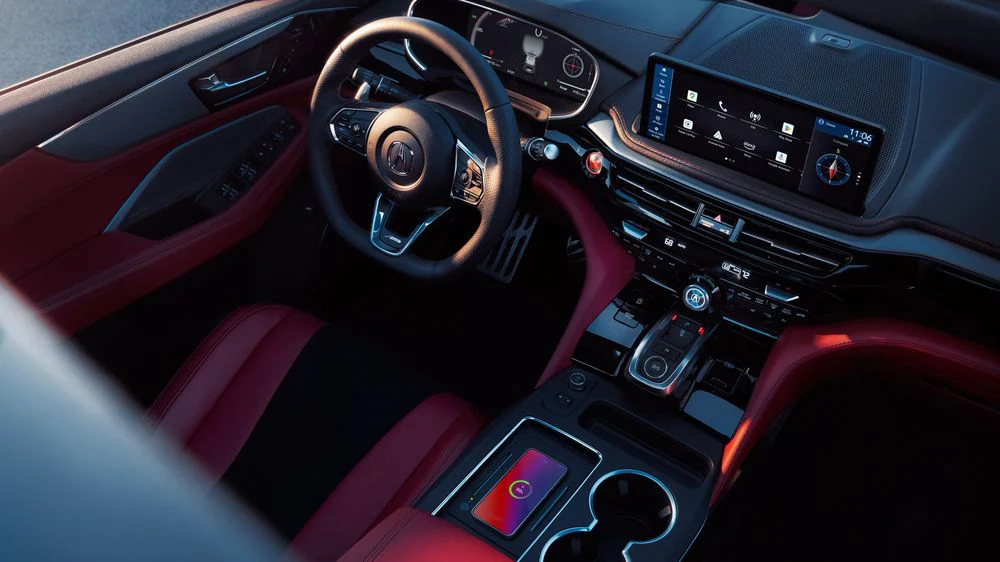
- Upscale, well-designed cabin
Cons
- Toggling between HVAC and media
- Middling EV range expected
- Likely the poorest value in the Sportage range
If you love the Sportage’s striking design and handsome interior but wish the compact SUV had all-electric range, you’re in luck. The 2026 Sportage PHEV can be charged for silent around-town driving, and its gasoline engine steps in when more power is needed or if the battery is depleted. We’re expecting a major update for the 2026 model year, with changes including a restyled exterior and new interior design details. Rivals to the Sportage PHEV include the Ford Escape PHEV, Mitsubishi Outlander Hybrid, and Dodge Hornet R/T PHEV.
Korean-market Sportage pictured above
What’s New
Here are the updates we expect to make their way to the 2026 Kia Sportage Plug-In Hybrid based on what we know about the revised Korean-market Sorento:
●Updated exterior styling to match the Kia EV9
●Taillights with a more geometric shape
●A restyled dashboard and center console
●A hideaway wireless charging cubby in place of an open binnacle
●A rotary shifter in place of a T-handle shifter
What We Think
There are two great reasons to choose the 2026 Kia Sportage PHEV over the gasoline and hybrid models. Kia’s compact plug-in hybrid SUV uses the most powerful powertrain on offer and is the quickest model in the range. It’s also the only version of the Sportage with standard all-wheel drive. In our testing, we’ve found power delivery to be smooth and effortless. The six-speed automatic provides smooth and decisive shifts. The brakes pedal feels natural and stopping power is decent. Ride refinement is generally excellent, but body roll and dive occasionally disrupt the Sportage PHEV’s otherwise well-tuned chassis.
For 2026, we’re expecting Kia to revise the Sportage PHEV’s exterior design with a new front fascia that recalls the three-row EV9 and freshened taillights. We’ve been fans of the Sportage’s stylish interior ever since the current-generation SUV arrived for 2023, but Kia is expected to take steps to further modernize the compact crossover’s cabin with a new dash design and a revised center console complete with a rotary shifter dial. The Sportage PHEV’s cabin makes use of clever accents such as hooks built into the backs of the headrests and configurable front-row cupholders, although the swappable bar that toggles between climate and media controls is a little too fussy for our tastes.
Where the Sportage PHEV stumbles is in an area that should be a core competency. The middling all-electric range is bested by rivals such as the Toyota RAV4 Prime and Ford Escape Plug-in Hybrid. Additionally, hybrid models can drive further on a full tank of gas and are only a couple of tenths slower to hit 60 mph from a standstill. As such, the PHEV’s higher starting price makes it a dubious value compared to the Sportage HEV. However, those who can make the most of the plug-in hybrid’s all-electric range will find the Sportage PHEV to be a pleasant daily driver.
Performance, Efficiency, and Range
Regardless of trim, the 2026 Kia Sportage PHEV is expected to come equipped with the same powertrain as last year. A 1.6-liter turbocharged I-4 works with an electric traction motor and a six-speed automatic transmission sending power to a standard AWD system. Output totals 261 hp and 258 lb-ft of torque, making the Sportage PHEV more powerful than the conventional hybrid by 34 hp. In our testing, the Sportage PHEV accelerated from 0-60 mph in 7.1 seconds, beating the HEV by 0.2 second. The gas-only model does the deed in 9.3 seconds. There’s a much quicker compact plug-in hybrid SUV on sale, however. The RAV4 Prime gets the job done in 5.5 seconds.
The most recent version of the Sportage PHEV evaluated by the EPA was the 2024 model, which returned 84 mpg-e on gas and electricity. All-electric range, enabled by a bigger battery than what Kia outfits to the HEV, is 34 miles. Total driving range is 430 miles. The Sportage Hybrid, most recently rated for 2025, delivers 42/44 mpg city/highway with FWD and 38/38 mpg with AWD. Its driving range is much better than that of the PHEV. FWD variants can drive 589 miles on a single tank and AWD models are rated at 521 miles.
Safety Features
We expect the 2026 Sportage PHEV to come standard with blind-spot and rear cross-traffic monitors, automatic emergency braking, lane keeping, rear parking sensors, and a driver attention monitor. Higher grades unlock a 360-degree camera, front parking sensors, and Remote Smart Parking Assistant, which can automatically park the vehicle. While the Sportage PHEV’s lane centering system is easy to operate, the SUV’s Highway Driving Assist system tends to gently ping pong in between lane markers.
Cargo Space and Interior Room
One of the tradeoffs Sportage PHEV buyers make is reduced cargo volume and second-row legroom compared to the gasoline-only and hybrid variants. We’re expecting interior dimensions to carry over for 2026.
| Legroom (front/rear) | Cargo Space (seats up/down) | |
| 2025 Kia Sportage Plug-In Hybrid | 41.4/39.5 inches | 34.5/65.5 cubic feet |
| 2025 Kia Sportage Hybrid | 41.4/41.3 inches | 39.5/73.7 cubic feet |
| 2025 Kia Sportage | 41.4/41.3 inches | 39.6/74.1 cubic feet |
Technology
Both of the 2025 Sportage PHEV’s X-Line and X-Line Prestige trims are well-equipped. We expect much of the compact SUV’s standard equipment to carry over for 2026, including a 12.3-inch touchscreen and a 12.2-inch digital instrument cluster. Apple CarPlay and Android Auto should continue to appear on all Sportage PHEVs. Six-speaker audio is likely to return as the standard offering, with an eight-speaker setup equipped on the Sportage PHEV’s higher trim.
