
Want to know if the car you’re shopping for can net you up to a $7,500 tax credit in the U.S.? This list will tell you.

The U.S. government and climate advocates want more electrified vehicles on the road, and they want them yesterday. The problem is that it’s not easy to get the populace to ditch their reliable gasoline-gulping cars and make the switch to hybrids or fully-electric vehicles . There are many obstacles in the way of the transition, but arguably the two biggest are availability and affordability. To address availability, some state governments like California will ban the sale of new gasoline powered cars by 2035 . Other states including New York are following suit. For affordability, the government is trying tax credits, which have updated into the 2025 year. Not every EV or plug-in hybrid (PHEV) makes the cut under the new criteria, and there are limits based on MSRP and other material qualifications. Fortunately, we have a handy list right here that details all the cars that are currently eligible!

How Does An EV Qualify For a Tax Credit?
- When President Biden passed his Inflation Reduction Act (IRA), it included some changes in regards to how an EV qualifies for the federal tax credit (when purchased; there are different credits for new vehicle leases and it works differently). Here’s what an EV needs to qualify for the federal tax credit in 2025:
Have a battery capacity of at least 7 kilowatt hours.
- Have a gross vehicle weight rating (GVWR) of less than 14,000 pounds.
- Be made by a qualified manufacturer.
- Undergo final assembly in North America.
- Meet critical mineral and battery component requirements .
- If the EV is a van, truck, or SUV its MSRP can’t exceed $80,000.
- For other EV vehicle types the MSRP can’t exceed $55,000.
Those last three requirements are among the biggest reasons why this list looks different now than it did back in early 2023. Here’s what makes the cut in 2025:

Acura
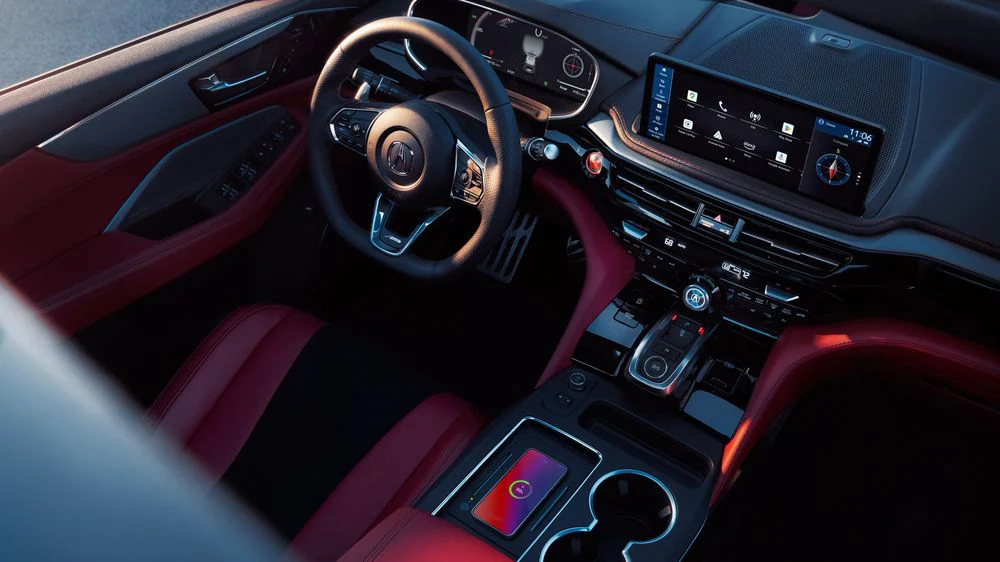
The 2024–2025 Acura ZDX gets a $7,500 credit up to the $80,000 MSRP limit. The ZDX is Acura’s first EV and shares a platform with the Honda Prologue and Chevrolet Blazer EV, so you can expect to find those vehicles on the list as well.

Chevrolet
- You might remember seeing the Chevrolet Bolt EV and EUV on this list last year but they’re both officially retired from the automaker’s line up. Replacing them are the shiny new Blazer EV, Equinox EV, and the very impressive Silverado EV truck.
2024–2025 Blazer EV (LT, RS, SS) | $7,500 credit | $80,000 MSRP Limit - 2024–2025 Equinox EV (LT, RS) | $7,500 credit | $80,000 MSRP limit
- 2025 Silverado EV (LT) | $7,500 credit | $80,000 MSRP limit

Chrysler
- The Chrysler Pacifica plug-in hybrid van returns for the 2025 model year largely unchanged, and is available for the full $7,500 federal tax credit up to the $80,000 MSRP limitation. The Pacifica is now Chrysler’s sole model, as the 300 sedan has been put out to pasture in 2023 and the brand’s upcoming flagship EV SUV is still under wraps.
2024–2025 Chrysler Pacifica PHEV | $7,500 credit | $80,000 MSRP limit

Ford
- For 2025 the only Ford EV that will net you a tax credit is going to be the F-150 Lightning pick up truck. For now the Mustang Mach-E is left out but we don’t reckon that will last long so if you’re holding out for the electric SUV stay tuned and we’ll update this list as soon as things change.
2024–2025 Ford F-150 Lightning (Flash) | $7,500 credit | $80,000 MSRP limit
- 2023–2025 Ford F-150 Lightning (Lariat) | $7,500 credit | $80,000 MSRP limit
- 2023–2025 Ford F-150 Lightning (XLT) | $7,500 credit | $80,000 MSRP limit

Genesis
- If you’re keen on picking up the Genesis GV70 but want to save some serious cash then you’re in luck—just buy the 2025 Genesis GV70 Electrified, which qualifies for EV tax credits in 2025.
2025 Genesis GV70 Electrified | $7,500 credit | $80,000 MSRP limit

Honda
- Honda joins the list in 2025 with the Prologue, its first electric SUV. The Prologue is part of the joint effort between Honda and General Motors that also birthed the Blazer EV and the Acura ZDX found elsewhere on this list.
2024–2025 Honda Prologue| $7,500 credit | $80,000 MSRP limit

Hyundai
- Hyundai is offering two vehicles that will net you the EV tax incentive this year. The Ioniq 5 compact electric SUV joins the list alongside the brand-new three-row Ioniq 9 which made its debut at the 2024 LA Auto Show.
2025 Ioniq 5 | $7,500 credit | $80,000 MSRP limit - 2026 Ioniq 9 | $7,500 credit | $80,000 MSRP limit

Kia
- Considering that the Kia EV6 and the larger three-row EV9 share platforms with the Hyundai Ioniq 5 and Ioniq 9 respectively, it’s no surprise to see the automaker’s offerings show up on the list right beside their cousins. Those looking to buy the smaller Kia Niro EV will be disappointed to know that it didn’t make the cut.
2026 EV6 | $7,500 credit | $80,000 MSRP limit - 2026 EV9 | $7,500 credit | $80,000 MSRP limit

Tesla
- Things have been a bit of a roller coaster for Tesla when it comes to EV credits. In 2023 and 2024 only the Model X Long Range was eligible for the tax credit, but with manufacturing changes at Tesla, the list of qualifying vehicles has grown significantly for 2025 and now includes the controversial Cybertruck.
2025 Cybertruck Dual Motor | $7,500 credit | $80,000 MSRP limit - 2025 Cybertruck Single Motor | $7,500 credit | $80,000 MSRP limit
- 2025 Model 3 Long Range AWD | $7,500 credit | $55,000 MSRP limit
- 2025 Model 3 Long Range RWD | $7,500 credit | $55,000 MSRP limit
- 2025 Model 3 Performance | $7,500 credit | $55,000 MSRP limit
- 2025 Model X AWD | $7,500 credit | $80,000 MSRP limit
- 2025 Model Y Long Range AWD | $7,500 credit | $80,000 MSRP limit
- 2025 Model Y Long Range RWD | $7,500 credit | $80,000 MSRP limit
- 2025 Model Y Performance | $7,500 credit | $80,000 MSRP limit

2024 EV Tax Credits FAQ
- How do I claim a 2024 EV tax credit?
At the moment, you’ll need to fill out IRS form 8936 and send it in with your tax return. However, in the near future you’ll be able to assign the credit to the dealership so that they can discount the vehicle at the point of purchase rather than waiting for your tax return.
How to get the full $7,500 2024 EV tax credit?
In order to get the full $7,500 tax credit, an EV must meet the critical mineral requirement and the battery component requirement. If it only meets one of the two requirements then the max credit it’s eligible for is $3,750.
What is the critical mineral requirement?
The 2024 critical mineral requirement states that 50 percent of the value of critical minerals in a newly-produced EV’s battery must be extracted or processed in the United States or a country with which the United States has a free trade agreement, or processed in North America if installing a recycled battery.
What is the battery component requirement?
The 2024 battery component requirement states that 60 percent of the value of an EV’s battery components must be manufactured or assembled in North America (includes Mexico and Canada due to a U.S. trade agreement).
What is the income limit for 2024 EV tax credit?
To qualify for the 2024 EV tax credit, your modified adjusted gross income (AGI) can’t exceed:
$300,000 for married couples filing jointly - $225,000 for heads of households
- $150,000 for all other filers
What about EVs delivered between January 1st and April 17th 2023?
EVs that were “placed into service” or taken delivery of between January 1st and April 17th in 2023 can still qualify for a federal tax credit up to $7,500, but the amount is calculated differently. It starts with a $2,500 base credit plus $417 for a vehicle with at least 7 kilowatt hours (kWh) of battery capacity. An additional $417 is added for every kilowatt hour of capacity up to the potential max $7,500 totally available.
